What happened to 1st year and where's 2nd year off to?
...because I've only got three years to finish this thing and frankly, the preceding 16 months has been pretty thin in terms of wonderful PhD stuff done. Though I'm told by the ubiquitious everybody that e-ve-ry-bo-dy (one and the same?) goes through the same thing and not to panic about it. I have to admit that I've not been panicking as much as simply burying my head in the sand; kinda similar I suppose.
So I went to my supervisors and said I was ready to work and it was time to crank up the gears and the volume and other metaphors. We worked out that I've about 15 months to submit or I'll have to wait another year then they sent me away to write my thesis introduction and table of contents: no time like the present and all that.
Today was fairly productive in that sense. Wrote 500 words of an introduction and a very reasonable looking TOC. During this task, most of the morning was spent in deciding on a font; you can't hand in a thesis in just any old font and I'm not leaving such important decisions until the last minute, my content maybe but not the font. I settled on 'Futura Bk' in the end after a shortlist of seven: we'll see if it lasts the month (maybe I should start a poll...).
The major brain matter of the day was of course the point of the exercise: what is my PhD on. The TOC really helped in this as it forced me to narrow down and categorise. I've managed to reduce my various compositional whims down into some fairly concrete ideas and most importantly they're realisable and interesting. I had a worry last year that I was going to be stuck writing a thesis on a topic completely marginal to the composition but that seems sorted.
The thesis will centre around three points: frequential harmony, proliferative automatatism and bounded improvisation. I can vaguely define all three of these at the moment but expect things to get a lot more definite as I hit the reading and prepare to defend myself against the assessors.
- Frequential harmony is easy, basing composition on frequencies rather than notes: this is just because most of what I write is concerned woth some sort of acoustic/psychoacoustic phenomena which is much easier to work out as frequencies then quantise (if it must me done...) to pitches that players can read: often I allow max/msp to play the more exacting harmonies.
- Proliferative automatism involves the relinquishing of control over some of the aspects of the composition and allowing a self organising automaton or process (in max/msp) to control it: this would most likely take the form of a cellular automata or strange attractor algorithm depending on the type of control required. The reasoning behind this is that most of my music moves slowly and spends a long time moving within extremely small pitch spaces: once I've decided on a macro section I'm not too concerned with what happens inside it at the note-level so I find it interesting to turn the note-level detail over to a process, especially in the knowledge that a player may be improvising/reactimg to this automata on a moment to moment level in ways which again I have no wish to micro-manage. On a completely unrigorous level I also enjoy the notion that these processes are alive in their own unknowing way.
Along the way I considered using genetic algorithms but they seem to me to be more useful when dealing with something where you want it to change quite radically across time, not suited to all my purpose at the moment but could be useful. (This section may be receiving a name change due to my only noticing today the connection between the term 'automatism' and surrealist-type writing conditions which is not an association that I particularly object to but it's way off my point.)
- Bounded improvisation differentiates itself from the prevailing modern forms, free improv. and directed. improv. in that a player is bounded by a set of idiomatic elements within which they may improvise: bounded improvisation is closer in technique perhaps to more ancient types of idiomatic improvising such as baroque music or folk musics. It may be more reasonable to say that I make my own idiom and expect the player to improvise within the stylistic norms of 'my' tradition. In the piece I set up an environment (computer part and player's harmonic/gestural vocabulary) and a set of interactions which define how the player and computer should respond to each other.
So that's the idea, next thing is to see how the supervisors react after I touch it up a little before emailing. Here's a lorenz attractor...
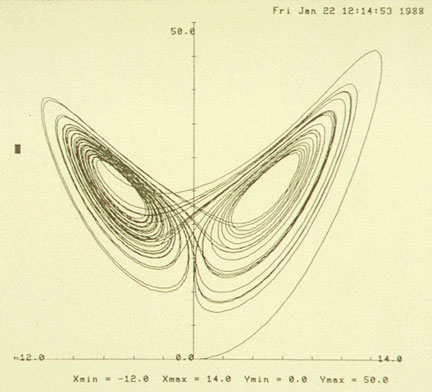
Labels: cellular automata, improvisation, music, strange attractor

0 Comments:
Post a Comment
Links to this post:
Create a Link
<< Home